
March 2026
Key points
- Most people use both gas and electricity in their households. These are both priced differently.
- In the UK, unlike in many other European countries, electricity is significantly more expensive than gas. This is largely because of additional costs, which are paid for via electricity bills.
- Currently, one unit of electricity is 4.7 times more expensive than one unit of gas. The difference between 4.7 and one is called the ‘spark gap’.
- The spark gap is an important factor in the move to electrifying homes and businesses because when it is higher than it could be, electric technologies (heat pumps, electric vehicles, etc) become unnecessarily expensive to operate.
- In order to increase the attractiveness and cheaper operating costs of electric technologies, the spark gap should be as low as possible, or, at a minimum, 2.5:1. The current spark gap of 4.7:1 is the highest it has been in recent years and among major European countries. It is a contributing factor to the UK having the lowest heat pump sales among 19 of Europe’s leading countries.
- In addition to building out more electricity generation, the spark gap can be reduced by removing policy costs from electricity bills.
- This is one approach taken by the Government in the 2025 Autumn Budget, when it moved some policy costs off the energy bill. This reduces the spark gap to 4.3 from April 2026 and is a very welcome first step.
- However, more could be done so that the spark gap reaches a level that delivers savings evident to households and businesses making the switch to clean heat.
What is the spark gap, and why does it matter?
- The spark gap is a ratio comparing the price of a unit of electricity to that of a unit of natural gas.
- For example, if a unit of electricity costs double what a unit of gas does, the spark gap would be 2:1 (or simply “two”).
- The spark gap is an important factor when thinking about encouraging households and businesses to electrify – in other words, replacing an oil and gas-dependent technology (boiler, car, etc) with a modernised version that uses electricity (heat pump, electric vehicle, etc).
- Moving to these types of technologies would generally reduce the exposure of UK, households and businesses to gas and play a part in providing more stable energy prices.
- But for this to work, the cost of running these technologies needs to be attractive – and this is why the spark gap is important. The lower the spark gap, the more cost-effective it is to run an electric technology.
- To electrify our heating, experts estimate a spark gap of 2.5:1 is desirable.1[1] This is the level where the total cost of ownership of electric heating (upfront and running costs) would be comfortably lower than a gas boiler. This is because air source heat pumps and heat networks tend to be around three times more efficient. A 2.5 spark gap should encourage rapid electric heat adoption.
What is the current spark gap in the UK?
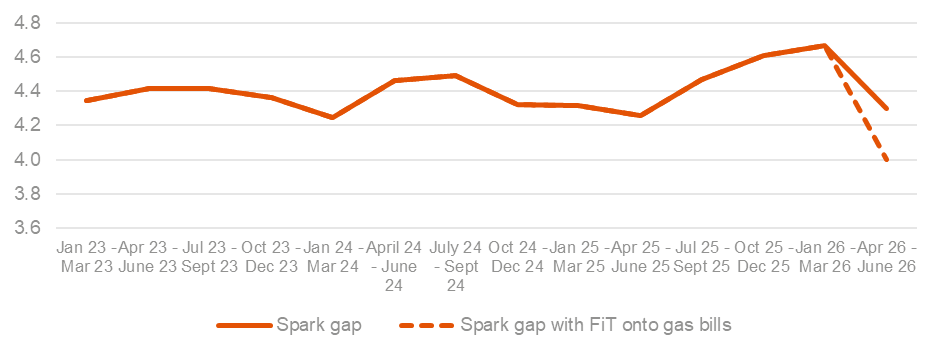
- Between January and March 2026, the domestic spark gap is 4.7:1, meaning a unit of electricity costs almost five times as much as a unit of gas. From April 2026, the spark gap will reduce to around 4.3:1.
- As shown in Figure 1 below, it has been steadily increasing since Q2 2025 and is now at its highest level it has been in the last three years.
Figure 1: Evolution of the domestic spark gap over the last three years[2]
- For businesses or customers who aren’t households, referred to as ‘non-domestic’ customers, the spark gap varies significantly.
- This is often due to exemptions and support schemes, but also because of how contracts are negotiated, depending on consumption levels and any risk of taking on the business as a customer. Energy UK estimates the spark gap for non-domestic customers ranges between 3.8:1 and 6.5:1.
- Energy UK has produced several explainers on the non-domestic market.
How do the UK’s neighbours compare?
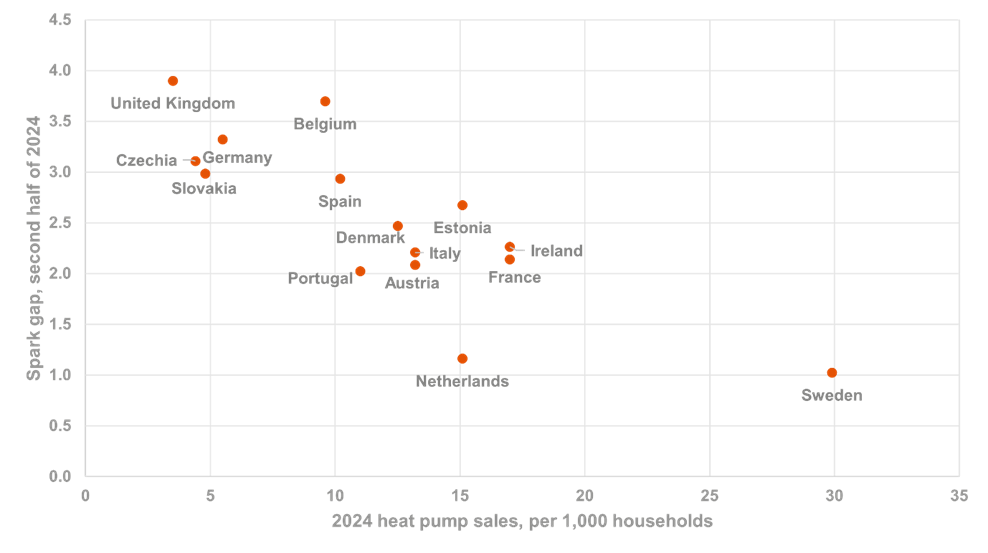
- The UK has the highest spark gap of economies that are part of the International Energy Agency.[3]
- This is partly because successive governments in the UK have funded various social and environmental schemes via electricity bills. This has made electricity disproportionately expensive relative to gas.
- As a result, the UK sells the fewest heat pumps per capita, among all 19 countries represented by the European Heat Pump Association.[4] Scandinavian countries, specifically Norway and Sweden, have the lowest spark gaps, and sell the most heat pumps.
Figure 2: Spark gap and heat pump sales in selected European countries[5]
How can we reduce the spark gap?
- Reducing the cost of electricity must be a priority.
- One of the most effective ways the Government could lower electricity bills immediately is by reducing or removing some policy costs and, ideally, paying for them via general taxation.
- These costs are important and need to be paid for; doing so via taxation would be the most progressive way since, currently, households with lower incomes pay a disproportionate amount towards these costs compared to higher-income households.
- However, the Government may decide to move some of these costs onto gas.
- The decision as to whether to shift costs onto taxation or gas bills is a nuanced one.
- While funding levies through gas bills is, in simple terms, more effective in reducing the spark gap, there is a risk of a negative impact on high gas users if not introduced without great care.
- Moving costs to taxation avoids this issue, but will not make as big an impact on the spark gap. It would also use some of the Government’s limited fiscal headroom.
- In the Autumn Budget 2025, the Government announced measures to lower domestic energy bills from April 2026. This included moving 75% of Renewables Obligation costs from electricity bills to taxation. This will cost £3 billion through 2026-27 and an average £2 billion in 2027-28 and 2028-29, before the subsidy is removed in 2029-30.[6]
- The Government also announced that the Energy Company Obligation (ECO) scheme will end on 31 March 2026, lowering both electricity and gas unit rates for households. This creates headroom to rebalance some policy costs from electricity to gas, while still delivering a net reduction in gas bills.
- These two measures will reduce the spark gap to 4.3.[7]
- Energy UK has previously explored various options aimed at reducing the spark gap in the report Clean Heat: Balancing the bill.
For more information on this explainer, email MPSupport@energy-uk.org.uk.
References
[1] RAP (2025), Tipping the balance: Cheaper electricity is needed to drive clean heating
[2] Energy UK analysis
[3] ONS (2025) – The impact of higher energy costs on UK businesses: 2021 to 2024
[4] EHPA (2025), Analysis: high taxes on electricity are slowing heat pump uptake
[5] Eurostat (2025), Gas prices for household consumers, Eurostat (2025), Electricity prices for household consumers, Nesta (2025), What does the Budget mean for energy bills?, EHPA (2025), Market data; Energy UK analysis
[6] OBR (2025) – Economic and fiscal outlook November 2025
[7] Other things being equal.
Downloads
-
Energy UK Explains – The spark gap – 31 March 2026
Type: PDF (235 KB)


