Insights
Balancing the system
By 2030, most of our electricity will come from variable low carbon generation such as wind and solar. At the same time electricity demand will increase as transport and heating become increasingly electrified. New technologies will help us to change the way we use energy, not only helping to balance the system but reducing overall system costs, benefitting all consumers.
National Electricity System Operator (NESO)
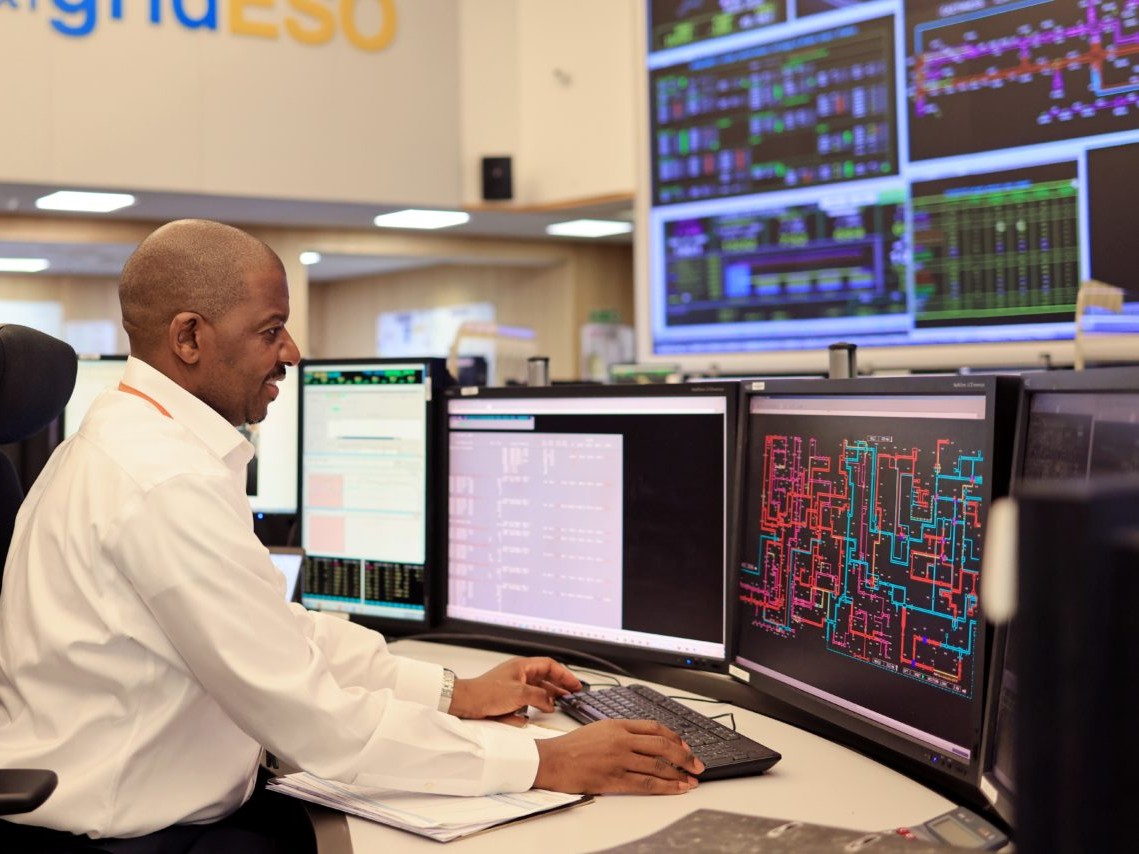
NESO is responsible for ensuring that supply meets demand for every second of every day, and the frequency of the system remains at 50Hz. This is a complex, challenging role given that demand and supply both fluctuate with weather, seasons, planned or irregular events such as those swayed by television programmes or events. Ensuring the smooth running of the grid requires the system operator to work with power generators to provide ‘ancillary services’ – a set of processes that keep the power system in operation, stable and balanced.
To experience what it must be like to carry out this role, NESO has developed an interactive game where you are tasked with keeping the grid stable while facing some of the challenges faced by the NESO control room on a daily basis.
Flexibility
System flexibility is the ability to adjust supply and demand to achieve that balance, and to help manage locational constraints on the networks over different timescales, from minutes or less to across seasons or even years.
To integrate the scale of low carbon technology coming on-stream (including a four-fold increase in offshore wind and five-fold increase in solar), the energy system will require a huge increase in flexibility provided by energy storage, interconnectors, and demand-side response, from around 13GW in 2023 to 50GW by 2030. The expansion in low-carbon technology alongside flexibility on the supply-side and demand-side will ensure that the future Net Zero energy system has sufficient supply during challenging periods. Studies show that a flexible grid could save the UK £10-17 billion per year by 2050 by reducing the need for dedicated back-up generation and grid reinforcement requirements to meet peak demand.
The changing grid
Flexibility in today’s grid is mainly supplied by unabated gas generation but the ambition to operate a Net Zero grid by 2035 means finding other solutions. The Government, with the regulator Ofgem, and NESO has set out an approach to delivery in the joint Clean Flexibility Roadmap.
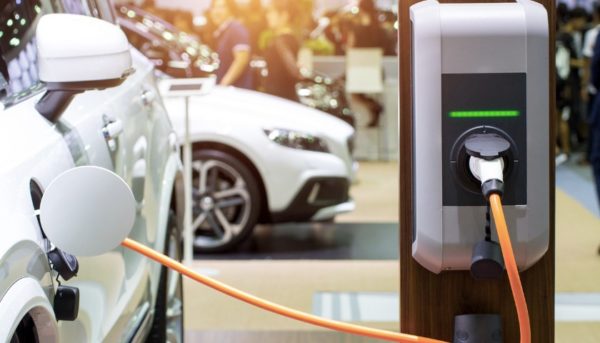
Demand-side flexibility (when demand is shifted either manually by customers delaying consumption, or automatically via smart assets such as electric vehicles (EVs), heat pumps or behind the meter batteries), shorter duration grid-scale batteries, and interconnectors can provide shorter duration flexibility.
Longer duration energy storage (LDES) technologies (such as the pumped hydro stations already in use across the UK, longer duration batteries and compressed air) as well as dispatchable low carbon generation (such as gas generation paired with carbon capture technologies, hydrogen power and bioenergy) will provide longer duration flexibility.
System functions provided by flexible assets include frequency response, energy balancing, managing constraints and system adequacy.


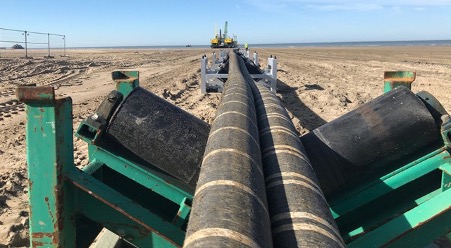
Interconnectors that connect our system to that of other nations, and other developing technologies like hydrogen storage, compressed air energy storage and more can also be expected to play a part in keeping the future system in balance.
All of these technologies present an opportunity for the UK to be a global leader in flexible technologies, and show significant potential for investment and international trade.

Constraints
When power generation exceeds the physical capacity of the local grid to export it, this causes a constraint on the network, and often means that generation has to be curtailed, i.e. turned down or turned off.
Alongside the necessary increase in ambition and delivery of network expansion, energy flexibility can relieve network constraints – in the short-term whilst networks are being expanded and in the long-term by helping to reshape demand so that it better aligns with supply.
Demand-side activities
Flexibility can also be provided at the demand side by customers varying their usage so they draw less or more from the grid at specific times.
Customers shifting their usage away from ‘peak’ periods when electricity is more expensive to produce and into periods when supply is plentiful and from low cost renewables reduces bills. It does this by reducing the wholesale price (more demand is met by low rather than higher cost supply) as well as reducing the need for extra generation and network capacity to be built.
Shifting demand in this way can be referred to as demand-side response (DSR), demand side flexibility or consumer-led flexibility (CLF).
Industrial DSR
Businesses can make money, save on bills and lower carbon by shifting energy use in real time.
This could include temporarily switching off fridges in supermarkets, or amending manufacturing processes to use electricity in non-peak times.
DSR for homes
The growth of controllable low-carbon technologies (LCTs) in the home, such as electric vehicle charging equipment, heat pumps, storage heating and domestic batteries mean more people can take advantage of demand shifting. When these small individual loads are aggregated across a range of homes and businesses into a single coordinated response, sometimes referred to as a virtual power plant, they can provide grid and balancing services in a similar way to a conventional power plant. Businesses can make money, save on bills and lower carbon by shifting energy use in real time.
The emerging market for smaller assets – such as EV charge points, domestic battery storage, heat pumps – to play into whole-system balancing is developing at speed across both small to medium enterprises and domestic markets.
While electrification of heat and transport will increase overall electricity demand, low carbon technologies allow consumers to play an important role in balancing the grid and reducing system costs. Many of these technologies operate automatically, for example, through smart charging, where EV charging is adjusted in response to grid signals, drawing power when electricity is abundant and reducing demand or discharging energy to the grid when generation is lower.
To support this development, government is working with industry to introduce regulations that ensure all low-carbon technologies installed in homes are secure, protect consumers, and support the electricity grid as electrification increases. These regulations include enhanced cybersecurity and optional smart functionality and are being designed to allow technologies to respond to price signals and shift electricity use to off-peak periods. This will help households take advantage of flexible tariffs and help to reduce their energy bills.
Demand Flexibility Service (DFS)
Following the invasion of Ukraine in 2022 and the disruption this caused to global gas supplies, the UK’s System Operator developed additional winter measures to ensure that system margins remained adequate. These included contracting retired coal plants to stand by and procuring a new DSR-product.
Energy UK supported the System Operator with the development of the service so that it could be designed, procured and approved in four months. To encourage untapped domestic and non-domestic DSR to come forward, approved providers were guaranteed twelve one-hour tests between November 2022 to March 2023 at a minimum price. This supported providers to engage and allowed industry and the System Operator to test customers response and the reliability of ad hoc, day-ahead domestic DSR as a balancing tool.
NESO has continued to innovate the DFS as the main route to market for DSR alongside reforming existing markets to enable DSR to compete alongside other assets.
In November 2024, the DFS transitioned to function as an in-merit margin tool. This change shifted it from a system adequacy tool (‘keeping the lights on’) to an everyday balancing tool.
A further change from April 2026 (if approved) would see demand turn-up and some generation (such as wind and solar connected to distribution network operators) turn-down included as well as a change to regional procurement – over time this would provide NESO with a further tool for managing network constraints.
You can find out more about the NESO’s work below via the following links. Energy UK has supported this work by feeding into these changes (see our Publications page for specific responses).
Since December 2025, NESO has been aided by Elexon working in a newly created role of Market Facilitator, which is leading on the development of market rules, systems and governance to enable DSR.
Power Responsive – a stakeholder initiative that covers both domestic and industrial and commercial DSR and storage