June 2026

Electrifying heat will bring economic benefits across the country, creating opportunities and jobs for both the existing workforce and next generation. These will span different technologies, offering rewarding and well-paid careers.
In this paper, Energy UK provides an overview of the jobs potential in the clean heat sector and shows where reforms to the skills system are needed to realise the ambition of the Government’s Warm Homes Plan.
Executive summary
The full economic potential of the transition to clean heat remains untapped. At the start of 2026, the UK Government published the long-awaited Warm Homes Plan, outlining £15 billion of public investment into lowering energy bills with energy efficiency and low-carbon technologies, including low-carbon heat, over the coming years.
Alongside affordability, one of the central themes of the Plan was the economic growth opportunity of the clean heat sector. The Government estimates the Plan will unlock £38 billion in total investment over the next four years, delivering significant rewards to UK workers and businesses.
Energy UK’s Clean Heat series shows how the transition to clean heat can be delivered in a way that lowers bills for energy customers, boosts economic growth, and creates jobs across the country. This paper unpacks the current domestic skills and supply chain landscape, beginning with an exploration of the existing and potential opportunities, and routes into the low-carbon heating sector.
These opportunities cover a broad range of technologies and occupations, from heat pump and other low-carbon heating technology installers to welders and pipe layers working on heat networks projects, and from engineers and designers involved in heat pump and thermal storage technology manufacturing, all the way to quantity surveyors leading on heat network procurement. Indirectly, increased demand for electrified heat will also drive an expansion of the roles needed in the electricity generation, transmission and distribution sectors.
Building on interviews with experts from across industry, this report combines fresh insights with findings from previous research to showcase how the decarbonisation of heat will be delivered.
If this rollout is successful, the economic benefits will be significant. The Heat Pump Association UK estimates that by 2035, the total Gross Value Added (GVA) generated by manufacturing, installing and operating residential space heating appliances alone could rise from £12.2 billion today to £22.5 billion in 2035. In total it will support 143,000 people in full-time employment, with around 140,000 of those roles focused on heat pumps. [1]
But this report also argues that there remain significant barriers to the expansion of the workforce, as envisioned by the Warm Homes Plan.
The sector faces a looming ‘chicken and egg’ dilemma, as the artificially high cost of electricity continues to hold back demand for clean heat technologies. This in turn negatively impacts investment in skills, which will then hinder deployment growth once demand does increase as a result of the Warm Homes Plan announcements coming into effect. In short, the existing workforce lacks the capacity to deliver the transition at the pace and scale which will be required.
The challenge is two-fold: to harness the talent in the existing workforce and to bring in new entrants into the sector. Currently, a workforce approaching retirement combined with complex entry routes, a gap in awareness and a lack of sufficient funding for training costs all pose a serious threat to the development of a pipeline of skilled talent.
In addition, the underlying skills system is not prepared to keep pace with the surge in demand needed to achieve the Warm Homes Plan ambitions. This paper provides an overview of the existing policy framework supporting investment in jobs and skills in the clean heat sector, but also more broadly. It identifies where the gaps lie and makes the following recommendations:
Support investment in workforce skills and supply chain capabilities
- Introduce low-cost loans or bursaries to help cover the full scope of retraining costs and reform the Heat Training Grant funding structure to cover more advanced courses.
- Co-invest publicly and privately in training facilities and supply chain capabilities, including UK manufacturing capacity for low-carbon technologies.
- Secure a favourable EU deal to protect domestic manufacturing from import restrictions.
Raise awareness of opportunities in the sector
- Introduce coordinated work experience schemes and low-carbon heat awareness programmes in schools.
- Develop a national database of training provision to identify gaps and direct funding accordingly.
Build the future workforce
- Ensure schools highlight careers in low-carbon heat and support students into manual, on-the-tool careers in addition to academic routes.
- Reform the Growth and Skills Levy to increase apprenticeship starts and flexibility for employers.
- Introduce tax incentives for near-retirement engineers to mentor new entrants.
Opportunities and routes into development, installation and maintenance
Decarbonising our heating systems will require a broad range of different roles and skillsets, with an equally diverse set of entry routes.
The total number of new jobs that will be created will depend on the scale and pace of investment in the sector, as well as technology deployment and installation efficiency assumptions. It can also be hard to assign workers to a specific technology, as many will install and maintain several technologies at the same time.
Figure 1: Workforce growth (WPG) estimates[2]

Nonetheless, these are expected to be high-quality, productive, and rewarding jobs. Earlier government analysis based on online job advertisements suggested that salaries for jobs in heat and buildings were 11% higher than average job salaries in the UK.[3]
The majority of clean heat jobs in the near future will be filled from the existing workforce. Many heating engineers that have historically worked on oil and gas boilers will look towards retraining or upskilling opportunities to ensure they are also able to meet the expected growth in demand for low-carbon heat technologies.
But in the long-term, this retraining of the existing sector is unlikely to be enough on its own, especially when taking into account natural, retirement-driven attrition over the coming decade in the heating and plumbing sector. Heat pumps require larger teams to install, creating an additional need to expand the existing workforce.
The sector also lacks gender and ethnic diversity, which may limit the attractiveness to new entrants.
Installation roles are particularly exposed to these issues, with an employer survey suggesting two-thirds of heating and cooling installers are over 45 years of age, meaning many will enter retirement during the critical 2030-35 period.[4] To meet the sector’s replacement rate, there needs to be a much larger push towards hiring and training new people, but this is challenging given that the employer landscape is heavily fragmented and primarily led by sole traders and micro businesses, which tend to lack the financial capacity, long-term certainty, and resources required to invest speculatively in skills to meet growth projections.
These are all serious issues that would need to be addressed even if the UK wasn’t in the middle of an energy transition that is dependent on wide-scale adoption of low-carbon heating technologies. Heating is an essential service and there will always be the need for a skilled workforce with training and experience in the installation and maintenance of efficient energy systems.
For this growth in the workforce to materialise, there needs to be a much greater awareness of the different pathways into the sector, which would help create more demand for training and related opportunities.
Heat pump workforce
Heat pump deployment plays a strong role across all NESO’s Future Energy Scenarios and the recommendations of the Climate Change Committee for meeting the UK’s carbon budgets.[5][6] More precisely, the Warm Homes Plan estimates 450,000 annual heat pump installations by 2030. The quality of these installations is vital to raising consumer confidence in the industry, since poor customer experiences could risk the success of the rollout.
The most in-demand skills for installers are linked to knowledge of the heating system and include plumbing, electrical, building, heating, ventilation and air conditioning skills. Heat pump installations require a greater level of electrical competence than standard gas boiler engineering, as well as a capability to work with different refrigerants.[7]
There are over 1,801 MCS-certified heat pump companies within the current active installer workforce, which the MCS estimates employ 4.8 installers on average. This suggests that as of October 2025 there were around 8,650 MCS-accredited heat pump installers.[8] These estimates imply that in order to reach the Climate Change Committee’s implicit target of 40,165 trained heat pump installers by 2030, there needs to be nearly a fivefold increase in installers over the next four years.[9]
The people behind an installation
Heat pump installations are bespoke and vary from household.
- They usually involve a lead installer alongside a team of 3-4 people, usually including a qualified electrician who focuses on wiring up the heat pump. They collaborate to oversee the installation, commissioning, and handover of various elements, including the heat pump, upgrading cylinders, pipework, and electrical circuits.[10]
- Installers and heating engineers will also be seen by many as the frontline face of the clean heat transition. They have the potential to play a vital role communicating to customers the benefits of this technology, explaining how it works, answering questions, and advising whether a different low-carbon technology would be a better match depending on a home’s features.
- The commissioning and handover process that follows an installation involves a significant understanding of ‘aftercare’ and should also involve recommendations around the importance of having a smart meter, being on the right tariff, getting to grips with new heating controls, and knowledge of other complimentary low-carbon technologies like solar PV and battery storage that would help bring down the customers’ bills.
- Once in place, heat pumps require annual servicing which is provided by a service engineer, typically MCS-certified, who runs a range of tests, checks, and inspections to assess the safety, efficiency and performance of a system and ensure it is working correctly.

“The idea that we can install heat‑transfer systems that are far better for the planet than the technologies currently used in most homes and commercial buildings genuinely excited me. It made me realise that this sector isn’t just technical, it’s impactful, innovative, and essential for a more sustainable future.”
Meg Bradley, Intermediate Electrical Engineer (Heat Pump Solutions), Vital Energi
Pathways into the sector
For existing plumbing and heating installers, the switch to low-carbon installations involves some form of retraining. Many private training providers offer a three-day MCS-recognised course, and this is typically the kind of course that is funded via the Heat Training Grant.
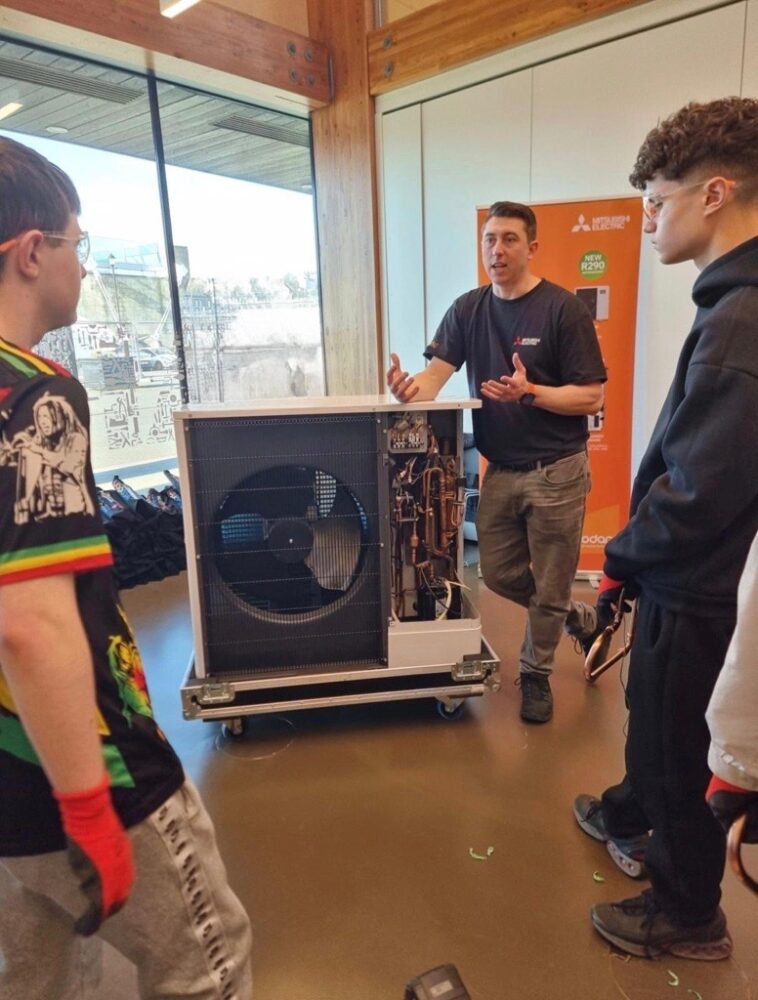
“What pushed me toward low-carbon heating was seeing how quickly the industry was beginning to change. It became clear that heat pumps and other low-carbon technologies were going to play a major role in the future of domestic heating, so I wanted to get ahead of the curve rather than wait to catch up later.”
Steve Clark, Technical Trainer, Mitsubishi Electric
New entrants into the workforce follow a different route and begin by learning the fundamentals of their chosen trade, normally at a college or through an apprenticeship. Figure 2 shows the different pathways new entrants can follow, which begins with a two-year Level 2 standard apprenticeship before moving on to additional qualifications.
Currently, the Plumbing and Domestic Heating Technician apprenticeship provides learners with an optional pathway in low-carbon heat towards the end of their course. The ongoing revision of the apprenticeship standard could introduce clean heat technologies into the core curriculum.
Such a reform would ensure that the pool of new plumbers and heating engineers is equipped to install a range of systems and advise people on the best technology type for different buildings, as well as help with emergency purchases of heating systems, so that a gas boiler is not the default option in these situations. However, colleges may face short-term delivery challenges due to staffing and equipment constraints.

The availability of training varies significantly across different regions, creating a postcode lottery system for training provision. Industry feedback also suggests a lack of targeted communications from the Government around the recently introduced Low-Carbon Heating Technician (LCHT) apprenticeship has limited its visibility.
Given the limited uptake and availability of LCHT apprenticeship, many businesses have designed their own certified apprenticeships and teaching programmes in partnership with local colleges, universities and training providers.
This trend is partly linked to a lack of local colleges offering the course independently, but also a desire for businesses to train people across a broader set of technologies tailored to their business operations.
For example, Vaillant has set up a strategic partnership with Derby College Group to create a three-year, Level 3 Low Carbon Heating Technician apprenticeship course that includes on-the-job training with qualified heating engineers. This course combines a mix of heat pump and other low-carbon technology training alongside additional qualifications and skills, such as plumbing, bricklaying, plastering, electrics and customer service, to ensure learners are fully equipped to carry out quality work. Upon completion, they can choose to either stay with Vaillant or move on to start their own heat pump business and grow the domestic supply chain.
Similarly, Centrica is opening a £35 million Net Zero training academy in Lutterworth, Leicestershire. The new academy strengthens Centrica’s ability to develop the next generation of talent, support apprenticeships, and equip more engineers with hands-on expertise in the technologies driving the energy transition and delivering reliable, lower-carbon solutions such as heat pumps for customers.
However, not all jobs related to heat pumps are in installation and maintenance. Many jobs will be created in the surrounding domestic supply chain. The Aldersgate Group estimates heat pump design and manufacturing can support 35% of total clean heat jobs, with the majority of those in electrical engineering, project management, and mechanical engineering roles.[12]
Heat networks workforce
Unlike heat pumps, where the effort needs to be focused on a combination of retraining the existing workforce and bringing new entrants in, the expansion of heat networks is predominantly an entirely new growth opportunity for new entrants, which will support a wide range of direct and indirect jobs.
According to the Heat Networks Industry Council (HeatNIC), there were an estimated 4,000 jobs in the sector in 2024.[13] Depending on the sector’s growth trajectory between 2025 and 2050, this number will continue to grow, and a preliminary estimate shows that around 48,000 jobs will be needed in the UK to deliver the target of 20% of heat in homes and businesses being supplied by a district heating network by 2050.[14]
Opportunities across the development lifecycle
Heat network jobs differ across the project lifecycle, ranging from project development, to commercialisation, construction, operation and growth, and the final asset transfer. They can broadly be divided into four categories:
Generation
- Requires specialist design engineers with mechanical, electrical, structural, and building skills, while the construction of generation infrastructure involves a broader range of engineering construction skillsets similar to those found in most infrastructure projects.
Transmission
- A high percentage of project cost is from civil engineering, such as trenching, excavation, and backfilling to build out the underground piping network, which draws on local, place-based roles including pipe laying and welding – some of which are accessible to people from non-technical backgrounds.
- These skills are expected to be in very high demand over the next several years, as utilities across telecoms, electricity, gas, and water carry out infrastructure replacements. Closer coordination between utility and infrastructure developers could help address potential capacity shortages while providing a long-term pipeline of work for civil engineers.
Maintenance
- Following construction, maintenance requires additional technical skills including central plant and heat network maintenance, water quality management, and alarm system monitoring. Connecting heat networks to customers’ buildings overlaps with the retrofit and built environment workforces, with more complex internal upgrades requiring a more specialised skillset.
Commercial and project management
- Across all of this, a considerable amount of commercial work must take place before project delivery can begin, spanning business development, quantity surveying, commercial modelling, stakeholder engagement, planning, legal, and estimating roles.
Many of these occupations do not always require full degrees and can be open to people without pre-existing technical skills or lower-level qualifications.
Training routes for heat networks
While all of these jobs will be vital to the growth of the sector, research conducted by HeatNIC in 2024 shows that there are currently persistent skills gaps in experienced, cross-disciplinary engineering and project management roles, as well as roles which require specific heat network expertise.
There is also a need to provide additional training to existing engineers, who may have the necessary technical skills but require stronger management and organisational skills to deliver complex projects.
Recruiting and retaining this specialised talent is an ongoing challenge, and since more than half the workforce has been recruited from outside the heat networks sector, there is a need for effective onboarding and training.
All of these routes have a variety of entry pathways, providing considerable options to people of different educational backgrounds and skillsets to enter the sector.

“A typical week for me consists of one day in learning, two days in the office, two days on site. Currently, I’m working on multiple projects that are all in different stages.”
Ciaran Connelly, Quantity Surveying Degree Apprentice, Vital Energi
Figure 3 shows two examples of the development pathways into the sector on offer. It shows that you can become a design engineer working on heat networks even if you do not go through the graduate route and started an apprenticeship straight after school.

Unpublished data courtesy of HeatNIC
Local jobs across the country
Heat networks are long-term infrastructure projects that create local employment opportunities throughout their development and operation, providing lasting economic benefits.
One example where we can see these opportunities come to life is Hemiko’s partnership with Birmingham City Council to develop the Tyseley Heat Network, which will supply low-carbon heating to schools, public buildings, commercial premises and industrial facilities across the area.
As part of this project, Hemiko is working closely with local contractors and supporting apprenticeships, trainee positions, scholarships, and jobs. These provide a route into the sector for Birmingham residents who are interested in a long-term career in a growing sector full of opportunity.
Beyond the initial construction, pipe network and heat interface, units inside people’s homes also require maintenance, leading Hemiko to launch a Heat Network Maintenance Technician apprenticeship programme alongside South City College Birmingham in 2025.
Given the broad range of opportunities in the sector, other firms have set up similarly wide-ranging courses aimed at new entrants. For instance, Vital Energi has developed its own graduate and apprenticeship scheme, and has partnered with Salford College to deliver it.
The scheme focuses on technical and craft apprenticeships, and is centred around a rotation system in different departments, so apprentices in their first two years can get a full appreciation of the business and which area they would like to pursue their career in, ranging from engineering to quantity surveying and finance.
Thermal energy storage systems
Heat batteries offer a good technical solution for both homes and businesses that are unsuitable for heat pumps or a connection to a heat network. Thermal storage can also offer a low-cost way of decarbonising heat needed for processes in industry. Following the introduction of residential heat batteries into the Boiler Upgrade Scheme, more installers will be incentivised to learn how to install this technology and suggest it to customers.
Alongside various types of heat batteries, smart hot water cylinders are another technology which can act as a form of thermal storage, helping to support the grid by providing flexible demand as well offering the possibility of bill savings. In some cases, this device can also be paired with an indoor heat pump, providing a practical solution for flats not on a heat network and where an external heat pump may not be viable.
The majority of plumbers and heating installers typically only need to complete a three-hour-online module to install a heat battery or a smart hot water cylinder, as they already have the main skillset required. The only other requirement is for government-funded installations to be MCS-certified, which will require completion of an MCS-recognised course.

“Once you understand the core principles behind how heat batteries work, moving over from gas is surprisingly straightforward… It’s a great feeling being at the “sharp end.” After years working on gas boilers that haven’t changed much for decades, seeing the same models day in, day out can get really repetitive, so it’s genuinely refreshing to work on something that feels like the future.”
Chris Tulk, Regional Field Service Manager, tepeo
Clean heat manufacturing and supply chain opportunities
Heat pumps
In the UK, air source Heat Pumps (ASHPs) accounted for the vast majority of units sold, representing approximately 82% of heat pump sales in 2025. Ground source heat pumps (GSHPs) and domestic hot water heat pumps (DHWHPs) were around 15%.
The Warm Homes Plan includes a target of 70% of domestic heat pumps to be made in the UK by 2035. It is estimated that in 2025, 36% of heat pumps sold were manufactured domestically.
However, UK sales are growing and there is significant scope to increase the proportion of heat pumps made here if there is sufficient domestic demand created through policy changes.
The UK is the largest producer of residential gas boilers in Europe and the fourth largest producer of air conditioning systems.[15] There is scope to repurpose manufacturing facilities and retrain workers to produce domestic heat pumps and ancillaries (such as compatible thermal storage and controls).
Figure 4: Heat pump sales in the UK (HPA UK)[16]

There is currently a high reliance on heat pump imports in the UK, although to meet future demand, it is anticipated that this dependence on imports will continue, in particular for ASHPs. There is a large international manufacturing capacity that can easily meet any envisaged growth in UK demand. Since 2019 there has been a European trade deficit due to an increasing reliance on imports from China.[17]
Currently, there are multiple manufacturers based in the UK, and existing boiler and air conditioning manufacturers clusters exist in the Midlands, Northeast and Scotland.[18] These include:
- Clade Engineering
- EcoAIR Box
- Global Energy Systems
- Ideal Heating
- Kensa
- Mitsubishi Electric
- Renewable Energy Devices
- Space Engineering
- Star Renewables
- Vaillant
The growth of these clusters and companies presents a valuable economic opportunity. UK-manufactured heat pump products are currently being exported across Europe, in particular to France, the Netherlands and the Republic of Ireland, as well as to countries further afield such as Australia and New Zealand. The UK also shows commercial leadership in natural refrigerant devices.
European sales have declined in recent years, with the European Heat Pump Association reporting a 21% fall in 2024 across 14 European countries compared to 2023.[19] The UK was an outlier, with a 63% increase during this period. This decline was due to changes to some government support schemes for heat pumps, slow economic growth impacting consumer confidence and the low price of subsidised gas.
More recently, however, heat pump orders across Europe have increased rapidly. Sales of residential heat pumps went up 25% in the first quarter of 2026 in France, Germany and Poland and 17% on average across the European Union (EU). Sales depend on a range of factors including the state of the national subsidy scheme, but experts cite rising gas prices and the fear of energy insecurity as important reasons for the recent rise, due to the conflict in the Middle East.[20]
The introduction of ‘Made in Europe’ policies being considered by the European Commission risk negatively impacting UK market growth by limiting opportunities to export to European markets. Economies of scale are crucial to the ramp-up of domestic manufacturing, and restrictions on exports to the EU could have a significantly detrimental impact to the competitiveness and growth ability of UK businesses in the clean heat supply chain.
Heat networks
There is a lack of in-depth analysis of the heat network supply chain to date. The generation equipment (which can be heat pumps, harvesting waste heat, ambient shared ground loops, or higher carbon options including combined heat and power and gas boilers) and thermal stores are sourced from a mixture of suppliers in the UK and across Europe.
Heat network pipework tends to be sourced from Poland, Denmark or Sweden, although the one exception is REHAU, which has a manufacturing plant for pre-insulated pipe in North Wales.
At the moment, there is not enough demand in the UK for new investment in a pipe fabrication plant. But a coordinated approach between heat network developers around procurement could present an opportunity to reverse this situation. This would improve heat network delivery, as importing heavy piping is expensive and challenging following the UK’s exit from the EU, due to delays gaining import certificates.
Heat battery supply chain
Heat batteries are typically heavy, due to the density of materials required to store high volumes of thermal energy in a compact appliance, and are therefore mostly manufactured in the UK. They represent a good opportunity for domestic engineering and assembly with significant job growth potential.
Current domestic manufacturing facilities include:
- tepeo manufacturers domestic heat batteries in its facility in Wokingham.
- Caldera undertakes initial product development and prototyping to full-scale production of its storage boilers at its Hampshire headquarters.
- Sunamp designs and manufactures its thermal battery products at its global headquarters near Edinburgh.
- Eskimo specialises in premium radiators and towel warmer systems manufactured at its factory in Birmingham. The company is developing an innovative hybrid radiator system designed to combine latent heat energy storage with electric heating.
Barriers to the expansion of the workforce and supply chains
Skills policy challenges
Policies to support investment in skills tend to not match the scale of need, and there is an unspoken expectation that businesses should cover the majority of training costs where viable. While larger businesses may have more resource to do this, in practice this can also mean that many individuals who are self-employed or working for smaller businesses bear the burden of funding their own training and upskilling.
This situation is complicated by the fact that the ‘warm homes’ sector is highly fragmented and dominated by sole traders and small businesses, which creates significant hurdles for the delivery of coordinated government approaches given capacity constraints.
Nonetheless, some measures have been introduced. To support retraining, in the Warm Homes Plan the Government extended the Heat Training Grant (HTG) with additional funding to 2029 to support the retraining of established gas heating engineers to learn the ‘top-up’ skills needed for heat pumps and heat networks work. For now, heat batteries have not been included in the scheme.
As grants are capped at £500 and generally cover only 70% of a short course’s cost, the scheme continues to depend on matched funding from installers to bridge the gap and meet the full direct and indirect costs of heat pump training, including lost revenue and travel expenses.
In total, Vaillant estimates that for installers, loss of income is between £251-£450 per day while they undergo training, presenting a significant barrier.[21] However, a shift towards more flexible training pathways over a longer period could allow installers to maintain core business activities while learning.
The Heat Training Grant can also be used to cover the cost of courses in heat network design, construction, operation and metering from a select number of providers, but take-up so far has been limited.
There are some concerns around the overall suitability of many of these short courses, which consist of around 20 guided learning hours across three days. They tend to be classroom-based with a focus on awareness building, but fall short on delivering the practical knowledge needed to enter the workforce and gain MCS registration, leading to a worrying conversion lag between training and heat pump employment. In fact, only 27% of newly qualified installers go on to complete a heat pump installation within a year of completing their training.[22]
Freshly qualified professionals will then need to practice their skills to learn from experience and gain competency and confidence. If qualified installers are unable to find work after completing their training, this will damage their confidence in their skillset.
Nesta has developed some pilot programmes to tackle these issues, including the ‘start at home’ project, where participants receive a free heat pump that they can then be trained to install in their own homes to boost practical knowledge, and build familiarity and confidence.[23] Other schemes revolve around piloting an installer peer mentoring network in order to promote knowledge sharing and help connect experienced installers with new entrants.[24]
All of these initiatives help tackle the challenging gap between finishing training and gaining experience through applying the skills learned during real-life installations.
A separate question is how to engage with a wider range of people to bring a new generation of entrants into the workforce. This is key, since the heating sector has a workforce nearing retirement and a shortage of younger engineers and installers. For example, in a survey completed in 2023, it was estimated that 28% of heating and cooling installers are aged 55-64, a figure that has now likely grown.[25]
A lack of diversity is another prominent issue, and according to the same study, 95% of the installation workforce is white and male. This may put people off entering the sector, and may also be a sign that the sector is limiting itself to an unnecessarily smaller pool of candidates
In heat networks, a 2024 survey by HeatNIC showed a slightly better picture. The proportion of female employees increased from 19% in 2022 to 24% in 2024 and 17% of employees were not from a White British background. The majority of surveyed companies also report having an Equality, Diversity, and Inclusion (EDI) strategy and 35% have signed the Industry Diversity and Inclusion Charter. The workforce was also younger, with an average age of 39 in 2024.[26]
Some technologies are also at a slight disadvantage. Thermal storage solutions are often missing from education and training materials in standard heating and plumbing courses. There is an opportunity to expand awareness of heat batteries in the clean heat technology mix, showing people the full breadth of potential solutions at the start of their career.
A flawed skills system
Beyond the heating sector, there are currently considerable failings within our wider education and training landscape that add barriers to new entrants and to the creation of a pipeline of talent in low-carbon heat. Many of these are linked to the apprenticeship system, which for years has consistently failed to meet the needs of industry and incentivise the uptake of apprenticeships in the low-carbon heat sector. Further detail on the required changes needed to take full advantage of the apprenticeship system can be found in Energy UK’s recent policy paper on the Growth and Skills Levy.[27]
The Apprenticeship Levy has been rightly criticised as inflexible, administratively burdensome, and poorly suited to SMEs. Funding cannot cover indirect costs such as equipment and transport; funding bands are outdated; and the removal of Level 7 funding restricts the upskilling of experienced engineers into advanced technical roles in areas such as commissioning. There are also concerns that funding pressures could extend to Level 6 programmes in the future.
Moreover, costs associated with apprentices go beyond wages. Businesses note reduced productivity in the first year, plus the time needed for supervision and training, as additional burdens. The Government’s support for SMEs announced in February 2026 – including £2,000 incentive payments for SMEs and full cover of training costs – provides some relief but is unlikely to be sufficient for many small companies.
Devolved skills policy also creates additional challenges for employers working across the devolved administrations hoping to deploy the levy strategically. Regional inequalities leave some areas of the country without viable teaching provision, hindering recruitment. Colleges, universities, and training providers are struggling to deliver the necessary courses due to a shortage of experienced teaching staff and technical equipment.
But there is also insufficient industry-led curriculum content across the education system. Even businesses that do run successful apprenticeship programmes struggle to recruit apprentices, due to a lack of awareness of the clean heat sector in certain areas of the country.
Against the backdrop of rising youth unemployment, with the number of people not in employment, education or training (NEETs) surpassing one million in 2026, there needs to be urgent action to increase apprenticeship starts across the board.
Supply chain policy challenges
The Government has taken some steps to improve domestic manufacturing competitiveness in the UK, but there remains an overall lack of pipeline certainty. The Warm Homes Plan sets out positive growth targets for heat networks, but the detailed policy mechanisms to ensure these are achieved are lacking. This will impact on investment in the skills required by the supply chain.
More could be done to ensure the expansion of the UK clean heat market goes hand in hand with the strengthening of local manufacturing jobs and supply chains.
The Clean Heat Market Mechanism (CHMM) requires heat appliance manufacturers to ensure heat pumps make up 8% of relevant boiler sales in 2026/27, with targets expected to scale over time alongside broader technology inclusion. However, the scheme currently does not include a UK preferential element, leaving domestic manufacturers under significant competitive pressure from imports, limiting investment in domestic manufacturing capacity.
The Government has increased the funding available for the second round of the Heat Pump Investment Accelerator Competition to £90 million. So far, only £9.3 million has been invested in the UK heat pump manufacturing supply chain, mostly due to market demand remaining below expectations.[28] Part of the problem is caused by the application process, which can be burdensome for smaller business, and the need for match funding creates additional difficulties.
Market growth policy challenges
The biggest barrier to growing supply chain capacity is the ‘chicken and egg’ dilemma, where companies will only invest in recruitment and training to deliver new technologies, and new entrants will only choose to train in skills for the clean heat sector if there is a clear and long-term pipeline of demand stretching beyond 2030 for these technologies. Read about this issue in more detail in other papers in Energy UK’s Clean Heat series.
Policy solutions
It is clear that attracting and retaining the workforce needed to meet Government ambitions for clean heat will require targeted efforts from both industry and Government.
Bigger companies in the sector are already investing in creating and delivering their own courses, but there remain challenges for smaller businesses, and there is a need for levels of coordination and funding which cannot be provided by industry alone.
While some initiatives are in place, such as the Heat Training Grant, they do not go far enough. There are a number of additional recommendations that will support the build-up of the workforce.
Support investment in workforce skills and supply chain capabilities
- Targeted low-interest loans for retraining costs: Introduce bursaries or low-cost loans where needed to maximise routes into the sector by enabling those retraining to derisk investment in acquiring new skills. This support could enable new entrants to enter the sector by covering the difference in pay as they train. For installers, it would also complement the Heat Training Grant and help cover the costs of time away from work to complete the training. Funding for the loans could potentially draw on the residual Warm Homes Fund or be an extension of the Lifelong Learning Entitlement set to be introduced later in 2026.
- Reform the Heat Training Grant funding bands to increase investment levels: The Department for Energy Security and Net Zero (DESNZ) should consider refining the funding model so that the HTG can cover the cost of more advanced courses in heat pump installations that are linked to an integrated, assessed competence standard.
- Strategic co-investment in training provision: Combine targeted public funding with a private sector clean heat skills investment fund for retraining people joining from other sectors and upskilling workers in SMEs, paid for by industry contributions and matched by Government funding. This could be used for example to finance new facilities in places where there are provision gaps, which can then be used by multiple clean heat and supply chain companies.
- Broaden existing support mechanisms: The Warm Homes Fund should be deployed to strengthen low-carbon supply chains. Coordinating area-based decarbonisation through local authority bulk procurement; deploying equity or loan finance to build UK manufacturing capacity, such as heat network pipework production; and funding workforce development beyond the scope of the Heat Training Grant.
- Secure a favourable deal with the EU: The Government must work towards an agreement with its European allies to ensure that the ‘Made in Europe’ initiative does not impose restrictions on imports from the UK that could undermine British manufacturing.
Raise awareness of opportunities in the sector
- Support and coordinate a work experience scheme: Theskills conversation needs to start at an early age, and the Government should work with industry to introduce a new coordinated work experience scheme to enable more young people to experience roles in the sector. This could aggregate opportunities across multiple companies that could host students for half-days and provide resource to match students with firms in their area, with common administration and safeguarding activities. As part of wider energy education, Government should also work with industry to run a low-carbon heat awareness programme in schools.
- Improved labour market intelligence around clean heat opportunities: Working across learning providers and industry, the Government should develop a publicly available national database with current public and private training provision. This would enable people entering the sector and companies operating in it to easily find local training for new entrants. It could identify gaps which could then be used to allocated enhanced funding to increase the provision of the Low Carbon Heat Technician apprenticeship in colleges in key locations where uptake is likely to be high, for example in areas with planned heat network development.
Build the future workforce
- Tackle the skills challenge from an early age through education reform: In the long-term, the solution to the UK’s skills challenge needs to start at an early stage in primary school. The recently reformed national curriculum should be introduced in a way that ensures students are made more aware of the applications of STEM subjects and highlights the range of career options in energy including heat. There also needs to be a broader cultural change in schools to encourage students to pursue a manual, on-the-tools career if they wish. Without a dedicated focus on this, there is a risk the pipeline to fill training spaces in apprenticeships and tertiary education will not be sufficient in size.
- Unlock the potential of apprentices: Reforms to the Growth and Skills Levy will be vital to increase apprenticeship numbers, and there needs to be larger levels of support for SMEs taking on an apprentice, as well as greater flexibility for employers.[29]
- Incentivise end-of-career mentoring: Tax incentives to encourage mentoring or training delivered by people nearing retirement could ensure that the knowledge of existing heating and plumbing engineers is passed on to people entering the sector or growing their skillset. This could include annual grants to cover expenses or increasing the tax threshold for retired workers.
Conclusion
Clean heat is a pressing case study for the consequences of investment in skills and training not keeping pace with evolving growth sectors. To tackle some of these shortcomings and help develop the skilled workforce, there needs to be a cohesive policy framework for skills which incentivises investment but also addresses funding shortages in education, training, and the broader skills system that all stand in the way of a sustained increase in training and recruitment.
The Warm Homes Plan and Future Homes Standard have made steps towards the right policy environment to unlock the potential of clean heat to achieve these aims. The focus now needs to be on how we shift gears towards tangible delivery, drive long-term investment in education and training to expand the UK clean heat market, and boost growth in the economy.
A successful transition to low-carbon heat will ensure customers feel the benefits of the transition towards a clean, secure, and lower-cost electricity system.
[1] HPA UK (2026), From Carbon to Competitiveness: The UK opportunity associated with decarbonising residential heating
[2] Deployment and heat supply assumptions based on Warm Homes Plan estimates. For heat pumps it estimates 450,000 installations per year by 2030 (and assume a 50% labour efficiency gain), and for heat networks, the figures are for direct jobs only and assume 27TWh of UK heat demand from heat networks in 2035 and 77TWh in 2050. Residential space heating figures includes heat pumps and assumes a 12% efficiency gain but does not include heat networks.
[3] DESNZ (2024), Clean Power 2030 Action Plan: Assessment of the clean energy skills challenge
[4] BEIS (2023), Heating and Cooling Installer Study
[5] NESO (2025), Future Energy Scenarios
[6] CCC (2025), The Seventh Carbon Budget
[7] For instance, F-Gas certification might be required for certain types of heat pump in the domestic market, although only a minority given monobloc ASHPs dominate.
[8] Aldersgate Group (2025), Workforce planning for clean heat. Where will the heat pump workforce come from?
[9] Nesta (2026), Six things to look out for in the UK Government’s upcoming Warm Homes Plan
[10] Commercial sized projects or split system heat pumps also require F-Gas certified refrigerant experts to both commission and maintain systems.
[11] CIPHE (2025), The New Level 2 and Level 3 Plumbing Standards – Frequently Asked Questions
[12] Aldersgate Group (2025), Workforce planning for clean heat. Where will the heat pump workforce come from?
[13] HNIC unpublished analysis.
[14] HNIC (2025), Written evidence submitted by Heat Networks Industry Council
[15] DESNZ (2026), Warm Homes Plan
[16] HPA UK (2026), Heat Pump Sales in the UK. This data includes factory gate sales of air-to-water (A2W) monobloc units, air-to-water (A2W) split units, ground and water source units, domestic hot water heat pumps (DHWHP) and ‘other – which includes exhaust air heat pumps and integrated hybrid heat pumps.
[17] IPPR (2024), The heatwave: Unlocking the economic potential of UK heat pump manufacturing
[18] IPPR (2024), The heatwave: Unlocking the economic potential of UK heat pump manufacturing
[19] EHPA (2025), Heat pump sales drop 21% in 2024, leading to thousands of European job losses
[20] European Heat Pump Association, 2026, Energy crisis sees rise in heat pump sales.
[21] Vaillant (2023) Vaillant installer survey report
[22] Nesta (2026) Why the heating sector needs to get hands-on to close the heat pump skills gap
[23] Nesta (2023) Start at home for newly trained heat pump installers
[24] Nesta (2025) Piloting installer peer mentoring networks to grow the heat pump sector
[25] BEIS (2023), Heating and Cooling Installer Study
[26] HNIC (2024), Workforce Skills Analysis (not available online)
[27] Energy UK (2026) The Growth and Skills Levy
[28] DESNZ (2025), Heat Pump Investment Accelerator Competition: successful projects
Downloads
-

Energy UK – Clean Heat – Jobs and skills for the future – June 2026
Type: PDF (1,005 KB)


