
April 2026
Key points
- Ofgem has set the price cap from 1 April 2026 at £1,641. This is for the typical dual-fuel (gas and electricity) household paying by Direct Debit.
- This is on average £117 cheaper than in the previous price cap period.
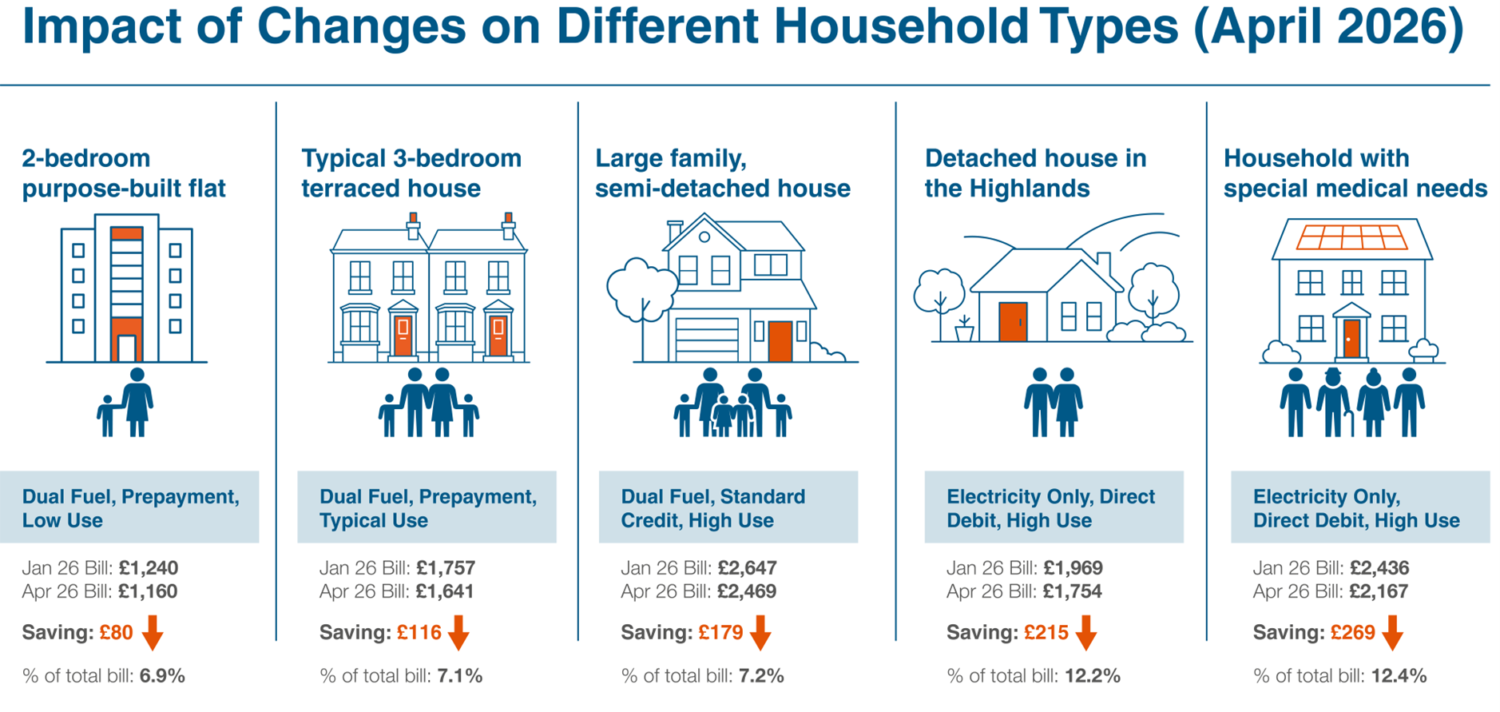
- What customers pay and how much they might save from April will differ based on their energy use.
- As announced in the 2025 Autumn Budget, the Government removed costs at an average of £150 for some households. This is around £134 per typical dual-fuel Direct Debit user.
- Additional energy network costs of around £65 have been added to the cap from April which reduce savings. This increase reduces overall savings but is needed to pay for essential network upgrades to modernise the UK’s electricity and gas grids.
- Additionally, costs related to the Warm Home Discount have moved from the standing charge to the unit rate, lowering the standing charge and energy costs for low energy users.
- Roughly 60% of customers remain on the price cap, while the 40% on fixed tariffs also receive savings announced from the Renewables Obligation – a cost added to bills to support early days renewables projects.
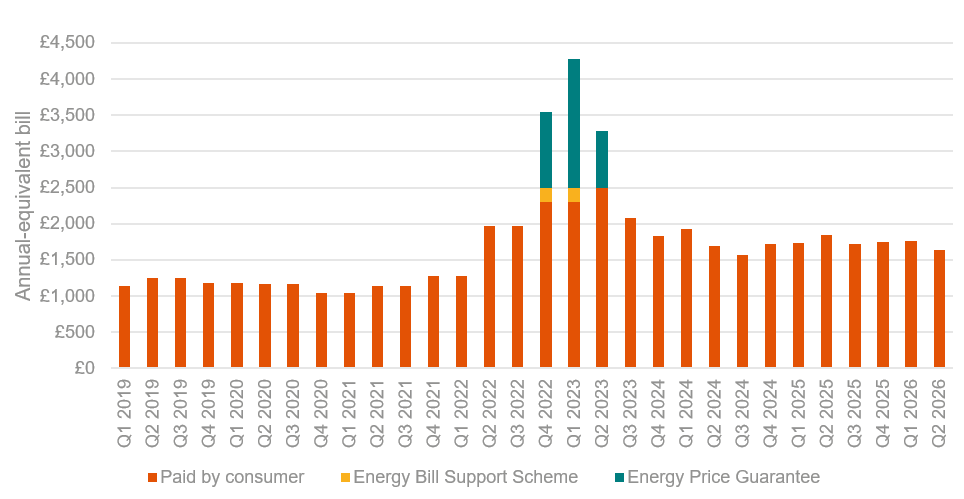
- The price cap has come down since early 2023 but remains 30% higher in real terms than before the energy crisis.
- Wholesale gas prices continue to be the main driver of costs on the bill. The long-term solution to reduce exposure to international gas prices is to build more clean British power, along with electrifying demand.
- It is critical that Government continue to make urgent progress to bring down bills in the near term and there are several ways to do this.
What has happened to the price cap?
- Despite significant volatility through January, the wholesale cost element of the bill (i.e. the price of gas) went down slightly during the observation window used to calculate the April to June energy price cap.
- Gas prices remain highly exposed to global events, so it is important to continue the drive to build more clean British power.
- As announced in the 2025 Autumn Budget, the UK Government took action to reduce bills by £134 for a typical Direct Debit customer.
- This was in two ways. The first was by moving 75% of the ‘Renewables Obligation (RO) off the bill and into general taxation. The second was by ending the charge which paid for the Energy Company Obligation (ECO).
- Both were known as ‘levies’ on the bill. The RO was a scheme set up to support the early days development of renewable energy projects. The ECO scheme, which supported energy efficiency schemes in vulnerable households, is being replaced.
- While the Government references a £134 typical saving (or an average £150), this will depend on a customer’s consumption and circumstances.
- The Department for Energy Security and Net Zero (DESNZ) has also moved the Warm Home Discount – another levy on bills – in the price cap from the unit rate to the standing charge. While this reduces the standing charge for low-usage customers, it will add additional costs to those with higher-than-average consumption. Overall unit rates for all customers are lower than before April.
- However, the grid also needs to be upgraded to meet the predicted demand of an economy reliant on more electricity. The cost of this essential infrastructure is estimated to add around £65 to energy bills in April, with further costs to follow in the five-year period thereafter.
What will changes mean for customer bills?
Why is the price cap still high?
- In the UK, the wholesale price of gas continues to predominantly set the price of electricity. This is because energy prices are set by the last generator needed to meet demand, typically a gas power plant.
- Despite the slight decrease from the previous quarter, the wholesale cost of gas remains higher than the long-term average before the crisis that began in 2022.[1]
- While the wholesale price makes up a significant proportion of an energy bill, a growing area of concern is the ‘non-wholesale’ component.
- This includes costs for essential upgrades to the grid, support for renewable energy and many other things.
- These additional costs need to be paid for, but recouping them through bills is regressive. Energy UK is urging the Government to continue to bring down bills by moving more non-wholesale costs off the energy bill and into general taxation, which is a fairer and more progressive way to split these essential costs.
- Energy debt is at a record high with official figures reflecting around £4.5 billion owed to retail suppliers, though Energy UK analysis suggests the true figure to be around £5.5bn.[2],[3]
- • The price cap includes a ‘debt allowance’ for suppliers to be able to recoup some of this debt, so they can operate sustainably. For the price cap from April 2026, the typical debit household pays nearly £50 to cover debt costs incurred from other customers while a customer on standard credit (payment on receipt of bills) is paying nearly £140.
- • Burdensome and, in some cases, ineffective regulation across the energy sector is also adding to energy bills.[4]
Figure 1: Price cap since 2021 (Source: Ofgem)
Why does the UK have higher energy prices than other countries?
- Although other economies also rely on gas, the UK is particularly exposed.
- Gas plays a vital role in the country’s energy system, across electricity generation, industrial needs and home heating, providing the heat source for nearly three-quarters of UK homes – far higher than most other developed economies. [5],[6]
- Until 2024, gas was the largest source of electricity generation but it has since been overtaken by wind.[7] As the proportion of electricity generated by gas reduces, with more clean energy technology on the system, the wholesale cost of electricity should also reduce.
- This impact has already been seen; analysis by ECIU shows that growth in British renewables is cutting electricity prices by up to a quarter.[8]
- Successive Governments have also used the energy bill to spread the cost for some of the additional policy, environmental or social costs as mentioned above, compared to other countries, which have funded some things through general taxation.
What can be done about energy bills?
- In the long run, building more clean British power will mean the country is less reliant on international fossil fuel markets and volatile prices.
- This is why the ambition of a clean power system is so important.
- People in Great Britain may also be paying for more than they need to, due to poor energy efficiency.
- The country’s housing stock is draughty, with around 50% of homes rated as below EPC C.[9]
- Improving energy efficiency and electrifying the economy would help to reduce bills permanently in the long-term.
And in the short term?
- National Energy Action estimates over six million households are in fuel poverty.[10]
- Households and businesses need more support. The record levels of debt are being driven by macro-economic conditions, as well as high energy bills.
- As a first step, households and businesses should always speak to their supplier if they’re struggling.
- Energy UK is calling on the Government to bring down bills in the near term. This should include:
- Continuing to move levies that pay for legacy renewables schemes from energy bills to general taxation to cut electricity costs for all households and support the adoption of low-carbon technologies, reducing exposure to volatile fossil fuel prices.
- Progressing data sharing efforts to enable the implementation of a better targeted support scheme using income, health and energy consumption data to provide sufficient help to those who need it most.
- Ensuring the smart meter rollout focuses on customer experience, complete the implementation of Market-Wide Half Hourly Settlement, and encourage demand flexibility to enable more households to receive cheap or free electricity when there is plenty of supply from the grid.
About Energy UK
Energy UK is the trade association for the energy industry, representing companies investing billions of pounds to secure our country’s current and future energy needs.
From growing start-ups to major electricity generators, grid and infrastructure developers and energy suppliers, our members are driving change across power, heat, transport and flexibility.
We provide a collective voice for the sector working with governments, regulators, charities and other organisations to provide crucial insight that shapes policy, offers solutions and promotes best practice.
Our broad view across the whole system supports evidence-based positions which are not tied to particular technologies, and are focused on delivering strategic benefits for people, businesses and the economy.
For more information contact press@energy-uk.org.uk.
[1] Energy UK analysis of gas prices
[2] Ofgem (2025); Debt and arrears indicator Q3 2025
[3] Energy UK (2026) Energy debt: Everyone pays
[4] Energy UK (2025); The future of energy regulation
[5] Energy UK (2024), Fuelling the Future; Progressing the gas transition for Net Zero
[7] NESO (2024), Britain’s Electricity Explained: 2024 Review
[8] ECIU (2025); Growth in British renewables cutting electricity prices
[9] ONS (2025); Energy efficiency statistics
[10] National Energy Action (2024), Homepage
Downloads
-
Energy UK Price cap Q2 26
Type: PDF (389 KB)


