
Key points
- The Renewables Obligation (RO) is a legacy UK government support scheme that helped drive investment in renewable energy and played a central role in building the UK’s renewable electricity generation fleet. Projects supported under the RO continue to provide more than 30% of our electricity supply.
- The scheme provides additional revenue to renewable generators by requiring electricity suppliers to source a proportion of the power they sell from renewable sources, demonstrated through Renewable Obligation Certificates (ROCs).
- Although the RO scheme closed to new capacity in 2017, existing projects continue to receive inflation-linked support payments, meaning the overall cost of the scheme can increase over time.
- Historically, the costs of the scheme were funded through electricity bills. From April 2026, following the Autumn Budget 2025, up to 75% of the domestic share of the RO will be funded through general taxation.
- A Wholesale Contract for Difference (WCfD) is a proposal that would allow eligible generators to voluntarily move onto a WCfD, which could provide greater price stability for consumers while offering generators more predictable revenues.
What is the Renewables Obligation?
- The Renewables Obligation (RO) scheme was introduced in the early 2000s and supported the development of the first generation of large-scale renewable infrastructure in the UK.
- Renewable generators accredited under the RO scheme receive financial support for up to 20 years, which helped drive investment in early renewable energy projects across the UK.
- This financial support played a crucial role in reducing the cost of developing renewables projects.
- The scheme places an obligation on electricity suppliers to ensure that an increasing proportion of the electricity they sell to customers comes from renewable sources.
Why was the RO introduced?
- The RO scheme was launched in 2002 as one of the UK’s first major policies to incentivise investment in renewable energy and increase the share of renewables in the system.
- The RO was successful in supporting the development of a large number of renewable projects, many of which play an essential role in powering the UK today. This makes it one of the most significant policies in the development of the UK’s renewable energy system.
- The scheme enabled renewable generators to earn additional revenue on top of the income they received from selling their electricity on the wholesale market. This helped support the construction of renewable projects at a time when costs were high and revenue was uncertain.
- The scheme closed to new applications in 2017, but accredited projects continue to receive support for up to 20 years, with payments expected to continue until 2037.
- In 2014, the Contract for Difference (CfD) scheme was introduced and later replaced the RO as the Government’s primary mechanism for de-risking investment in new renewable projects.
How does the RO work?
- The RO works through a system of tradeable certificates that provide additional income to renewable electricity generators.
- For every unit of renewable electricity produced, accredited generators receive Renewable Obligation Certificates (ROCs) from Ofgem. The number of ROCs issued depends on how much renewable electricity a project generates. Generators can then sell these certificates to suppliers or traders.
- Electricity suppliers are required to obtain and present specific number of ROCs to Ofgem to show that a proportion of the electricity they supply to customers comes from renewable sources. This requirement creates demand for ROCs and provides generators with a top-up payment to the price they receive when selling electricity on the wholesale market.
- If suppliers do not have enough ROCs to meet their annual obligation, they can instead make a ‘buy-out payment’ at a fixed price per MWh to cover any shortfall. The buy-out price is set by Government and is adjusted annually for inflation.
- At the end of each year, the money collected through buy-out payments is redistributed to suppliers that met their obligation by submitting enough ROCs. This creates an incentive for suppliers to purchase ROCs rather than rely on paying the buy-out price.
How much of our electricity comes from projects supported by the RO?
- The RO scheme played a crucial role driving the build-out of renewable infrastructure across the UK. Projects supported under the scheme provide over 30% of the UK’s electricity generation.
- In 2024/25, this scheme supported 26,644 accredited generating stations with a combined capacity of almost 35GW across technologies including offshore wind, onshore wind, solar, biomass, waste, and landfill gas.1
- The first projects to be accredited under the scheme are expected to begin leaving the scheme in 2027, as their support period ends. The number of supported generators will then gradually decline until the scheme fully winds down in 2037.
Figure 1: Cumulative renewable generating capacity available through accredited generators (MW)2
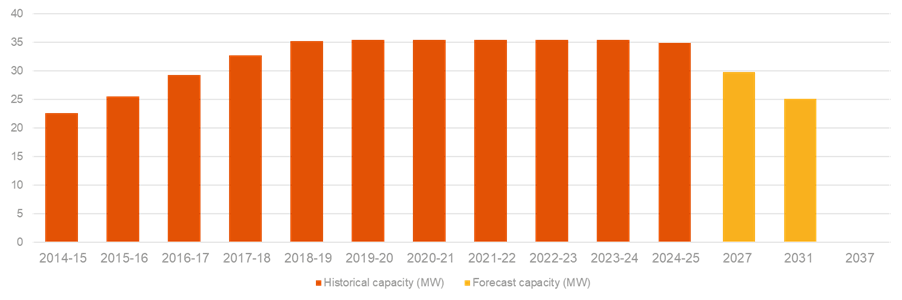
- Around 5.1GW of renewable capacity is expected to leave RO support by 2027. A further 4.7GW is due to exit by 2031, with an additional 25GW expected to roll off support by 2037.3
Are costs changing for customers?
- Historically, the costs suppliers incur under the RO, either by purchasing ROCs or making buy-out payments, were passed through to electricity bills and funded by customers.
- Following the Autumn Budget 2025, the Government announced that up to 75% of the domestic costs of the RO will instead be funded through general taxation from April 2026, reducing the share paid directly through household electricity bills. Non-domestic customers will continue to fund the full cost of the scheme.
- Because RO-supported generators sell their electricity at market prices, periods of high wholesale electricity prices can result in higher generator revenues. In 2022, the Government introduced the Electricity Generator Levy (EGL) which taxes exceptional profits during periods of high prices.4
- The Government has also announced a change to how the buy-out price is adjusted for inflation.5 From April 2026, the buyout price will linked to the consumer price index (CPI), rather than the retail price index (RPI) which the Government expects will reduce the future cost of the scheme.
What is a Wholesale Contract for Difference?
- The Government has proposed to offer ‘fixed contracts’ known as Wholesale Contracts for Difference, which would apply a similar concept to existing electricity generators that are not currently supported by a CfD.
- It would offer eligible generators the option to exchange their exposure to wholesale electricity market prices for a fixed price over a defined period. This would mean that both generators and consumers are less exposed to volatile gas-linked electricity prices.
- Under a WCfD, the intention is that the generator’s electricity would continue to be sold into the wholesale market as usual, and when the wholesale electricity price is higher than the strike price, generators pay the difference back to customers. When the wholesale price is lower than the strike price, generators receive a top-up payment. Having a fixed price provides revenue certainty for generators, helping to lower financing costs for projects, and provides greater price stability for customers.
- For generators currently accredited under the Renewables Obligation (RO), it is envisaged that their RO support would continue unchanged. This means that only the wholesale electricity revenue component would be replaced by the fixed-price WCfD, while their RO certificates and associated support would remain in place.
- The Government will only offer contracts to electricity generators where it represents clear value for money for consumers.
What are the benefits of offering CfD-style contracts to RO developers?
- It provides price stability for customers and revenue certainty for generators. CfD-style contracts provide generators with a fixed price for the electricity they produce, helping to stabilise revenues and reduce exposure to volatile wholesale electricity prices. It can also help insulate customers from volatility in wholesale electricity markets, including the sharp price spikes seen in recent years.
- It reduces exposure to gas-driven electricity price spikes. The UK’s wholesale electricity market operates using marginal pricing, meaning the price of electricity is often set by gas-fired generation.6 CfDs provide a natural hedge against high wholesale electricity prices by fixing the price paid for electricity from supported renewable generators. This helps to reduce the link between electricity prices and gas prices over time.
- It supports existing renewable projects to remain in operation. Over the next decade, an increasing amount of renewable capacity will leave RO support. Many of these projects may remain operationally viable but may face financial uncertainty and could permanently close without continued support. Providing access to CfD-style contract could keep these assets operating for longer, maintaining renewable generation on the system and reducing reliance on gas-fired power, as the more renewable energy in the UK’s generation mix, the less often gas will set the price of electricity.
For more information on this explainer, email kisha.couchman@energy-uk.org.uk.
[1] Ofgem (2025), Renewables Obligation Annual Report SY23
[2] Ofgem (multiple years), Renewables Obligation Annual Report
[3] UCL (2025), UK renewable energy cliff brings both risks and opportunities
[4] HMRC (2023), Electricity Generator Levy
[5] Energy UK (2025), Energy UK response to consultation on Renewables Obligation (RO) scheme: indexation changes.
[6] Energy UK (2026), Energy UK Explains: Why marginal pricing is the cheapest way to run our electricity market
Downloads
-
Energy UK Explains – The Renewables Obligation (RO)
Type: PDF (150 KB)