
Key points
- The Zero Emission Vehicle (ZEV) Mandate is a government policy that requires car manufacturers to sell a rising proportion of zero-emission vehicles each year or face fines.
- 80% of all new car sales must be zero-emission by 2030, and 100% of new car and van sales must be zero-emission by 2035.
- The Mandate is designed to ensure that flexibilities are built in that allow the car industry to meet targets by trading credits.
- Credits are earned for each zero-emission vehicle sold. Manufacturers that exceed the legal target can bank, borrow, or trade their credits to manufacturers that have not met the target.
- The Mandate is working in the way it was designed to work, with no fines issued in 2024.
- The switch to electric vehicles (EVs) is the single biggest driver of emissions reductions in the UK’s Net Zero Pathway, with EVs having cut UK emissions by more than seven million tonnes of carbon dioxide every year.[1],[2]
- Drivers are consistently choosing electric, with two million electric cars on the road, and new EVs now cheaper than petrol cars.[3],[4]
- The Mandate underpins billions of pounds of investment in the UK – across grid upgrades, charging infrastructure, AI innovation, and supply chains.
- The more we electrify, the more we help to spread the costs of electrification across a larger consumer base, helping to lower costs for everyone.
What is the ZEV Mandate?
The Zero Emission Vehicle (ZEV) Mandate is a policy that requires vehicle manufacturers to sell an increasing proportion of zero-emission vehicles each year, primarily through electric cars and vans.[5] Under current legislation, 80% of new car sales must be zero-emission by 2030, rising to 100% of all new car and van sales by 2035.
The ZEV Mandate has been the key policy driving transport electrification in the UK. Since its introduction, the UK has reached two million electric cars on the road, with electric vehicles now accounting for 23.4% of the new car market.[6]
Manufacturers that fail to meet their annual targets can face penalties. However, the scheme is designed with a range of flexibilities to support manufacturers.
Credits are earned for each zero- emission vehicle sold. Manufacturers that exceed the legal target can bank, borrow, or trade their credits to manufacturers that have not met the target. Manufacturers also need to meet targets for their petrol and diesel vehicles sold, ensuring they also have lower emissions.[7]
These flexibilities ensure the Mandate works with market conditions while maintaining a clear path towards zero-emission transport.
The Mandate is working in the way it is designed to. In 2024, all manufacturers avoided fines by meeting their obligations through a combination of vehicle sales and the scheme’s flexible compliance mechanisms.[8]
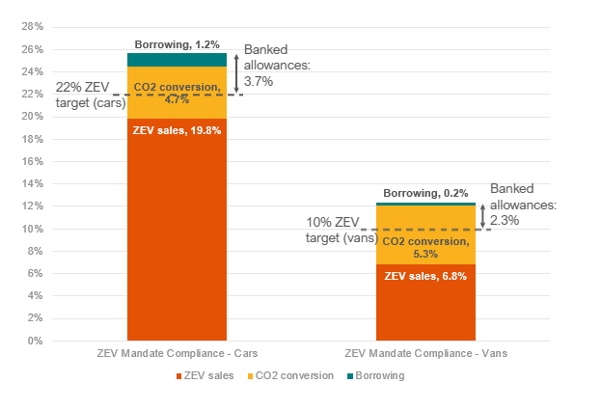
Figure 1: 2024 ZEV Mandate performance and use of flexibilities in the car and van market, illustrating both car and van market “overcomplied”. [9]
How does the ZEV Mandate help to save drivers money?
Electric vehicles don’t just reduce emissions; they help make the whole electricity system more efficient and cheaper to run, which helps to extend the benefits to everyone.
As more drivers switch to electric, the fixed costs of networks, charging infrastructure, and low-carbon generation are spread across a larger base of users. The more people who use the system, the lower the cost per person. Greater EV uptake also means charging stations are used more frequently, allowing operators to recover costs across more sessions and creating the conditions for lower charging prices over time.
EVs also add valuable flexibility to the grid. Because vehicles spend most of their time parked, charging can be shifted to times when electricity is cheapest, or when wind and solar generation is high. Smart tariffs already allow drivers to take advantage of this, helping drivers to save money through smart charging.
The result is a reinforcing cycle: more EVs mean lower infrastructure costs per user, which makes EVs more affordable, which encourages more people to switch. The more we electrify, the cheaper it gets for everyone.
Drivers are already starting to feel the savings from EVs. According to Autotrader, new EVs are now cheaper than petrol cars. [10] When charging at a private charger, charging an electric vehicle usually costs much less than filling up at the pump.[11] Electric vehicles are also far cheaper to maintain. They have fewer moving parts, no oil changes, no exhaust and no clutch – so servicing and repair costs are lower. [12] The Electric Car Grant of up to £3,750 closes that gap even further.[13]
These savings will become more pronounced as EV uptake continues, bringing costs down for consumers across the board.
How does the ZEV Mandate attract billions in investment in jobs, supply chains, and innovation in the UK?
The Government’s 10-year Industrial Strategy identifies clean energy and advanced manufacturing (which includes automotive) as two of the UK’s key frontier sectors. The Mandate and the Industrial Strategy are closely linked – with manufacturers and engineers across the country investing millions into the opportunity.
They are investing because they can see a clear, policy-backed market for demand-side electrification. EV production isn’t only about cars; it drives a ripple effect across supply chains, creating demand for supporting sectors such as batteries, gigafactories, and grid infrastructure.
The UK is also pioneering flexible energy solutions, with UK companies leading the way on AI solutions to manage smart charging and innovative customer offerings. Because these technologies are still emerging globally, early deployment gives UK firms an advantage, exporting technology and services around the world.
Companies are deeply involved in these systems, meaning the Mandate helps to pull entire supply chains into the UK. Without it, broader Government goals like the Industrial Strategy become much harder to deliver, causing companies to delay or retract investment in the UK market.
Why is the ZEV Mandate important for clean air and the environment?
The ZEV Mandate is the key policy tool to tackle emissions in the UK. Domestic transport is the most polluting sector in the UK, and cars, taxis, and light vans accounting for 70% of this.[14]
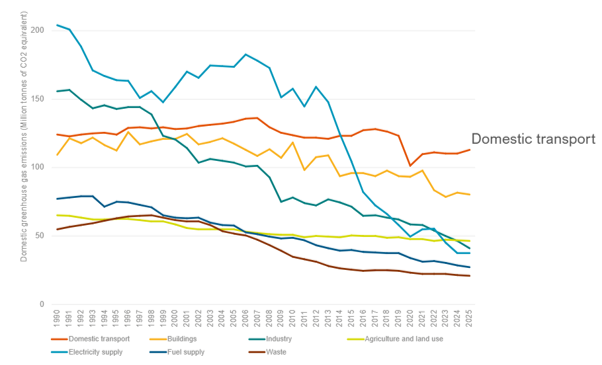
Figure 2: Domestic transport remains the highest emitting sector in the UK. The ZEV Mandate is key to bringing these emissions down. [15]
The switch to electric vehicles is the single biggest driver of emissions reductions in the UK’s Net Zero Pathway, with EVs having cut UK emissions by more than seven million tonnes of carbon dioxide every year.[16],[17] Electric vehicles produce no tailpipe emissions, meaning cleaner air across the UK.
The ZEV Mandate isn’t just about cars – it’s about creating cleaner air in our communities and reducing long-term pressure on public health services.
For more information on this explainer, email press@energy-uk.org.uk.
About Energy UK
Energy UK is the trade association for the energy industry, representing companies investing billions of pounds to secure our country’s current and future energy needs.
From growing start-ups to major electricity generators, grid and infrastructure developers and energy suppliers, our members are driving change across power, heat, transport and flexibility.
We provide a collective voice for the sector, working with governments, regulators, charities and other organisations to provide crucial insight that shapes policy, offers solutions and promotes best practice.
Our broad view across the whole system supports evidence-based positions which are not tied to particular technologies, and are focused on delivering strategic benefits for people, businesses and the economy.
We champion initiatives such as our Vulnerability Commitment, which pushes suppliers to go beyond regulation to support customers with additional needs, and TIDE, the industry’s drive for greater inclusion and diversity. Through our Young Energy Professionals Forum, we support the development of future leaders. We are equally committed to our team and are proud to be recognised as a ‘Platinum’ Investors in People employer.
[1] Climate Change Committee (2023) Zero-emission vehicle mandate
[2] Carbon Brief (2026) Analysis: UK emissions fall 2.4% in 2025 as coal hits 400-year low
[3] SMMT (2026) UK new car market breaches two million as almost one in four buyers go electric
[4] Autotrader Group (2026) New electric cars now cheaper than petrol on average for the first time
[5] Department for Transport (2025)Updates to the Vehicle Emissions Trading Schemes (VETS) Order 2023
[6] SMMT (2026) UK new car market breaches two million as almost one in four buyers go electric
[7] Autotrader (2025) What is the ZEV Mandate and why should you care?
[10] Autotrader Group (2026) New electric cars now cheaper than petrol on average for the first time
[11] Office for Zero Emission Vehicles (2025) Electric vehicles: costs, charging and infrastructure
[12] RAC (2025) The costs of running an electric car
[13] Department for Transport (2026) Zero emission vehicles eligible for a grant
[14] Department for Transport (2025) Greenhouse gas emissions from transport in 2023
[16] Climate Change Committee (2023) Zero-emission vehicle mandate
[17] Carbon Brief (2026) Analysis: UK emissions fall 2.4% in 2025 as coal hits 400-year low
Downloads
-
EUK – ZEV Mandate Explains
Type: PDF (223 KB)


