
April 2026
Key points
- Consumer-led flexibility (CLF) allows households and business to shift when they use electricity to benefit from lower prices or earn rewards for helping to balance the grid.
- In 2022, the Demand Flexibility Service (DFS) was the first of its kind in the world to mobilise customers to balance a national electricity grid.
- The DFS is relaunching in April 2026 with new features, including rewards for customers that shift their electricity use to times of high renewable generation.
- By 2026, it will be one of a number of flexibility services that allow customers to earn revenues for decreasing vary their electricity use at certain times to support the grid.
What is consumer-led flexibility?
- Consumer-led flexibility (CLF) is where customers voluntarily vary their electricity demand, to benefit from lower prices when energy supply is abundant or earn revenue for providing grid services during periods of low supply. Other names for CLF include Demand Side Response (DSR), Demand Response or Demand Flexibility.
- Not all demand is flexible but some activities such as electric vehicle charging can be shifted to times when electricity supply is plentiful. Flexible demand lowers overall system costs by reducing wholesale prices and reducing the need for additional generation and network infrastructure.
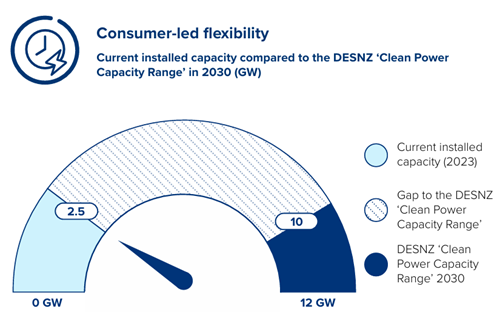
- Government has a target of 10-12GW of consumer-led flex by 2030. This is a four-to-five-fold increase on estimated 2024 levels of 2.5GW.
Why does consumer flexibility matter?
- As our electricity system is increasingly powered by variable wind and solar power we cannot control when they generate electricity, but we can change how and when we use electricity to align with their output.
- This reduces wasted renewable energy and ensures that a higher proportion of demand is met by the cheapest and cleanest sources.
- These savings benefit everyone, including those who can’t shift their electricity use.
Figure 1: Diagram showing current capacity compared to the DESNZ clean capacity range in 2030 (GW)1
How can customers provide flexibility?
There are two types of consumer-led flexibility.
- Tariff-led CLF: where an energy supplier offers lower-cost electricity when wholesale prices are lower. Tariffs can be static (e.g. fixed off-peak overnight rates) or dynamic (prices that track wholesale market prices in real time).
- Dispatchable CLF: is where many individual sources of demand (manual or automated) are grouped together (aggregated into a ‘virtual power plant’) by a provider to support the grid in a similar way to a small power station. This helps to keep the electricity system stable and reduce the need for more expensive back-up power stations. The National Electricity System Operator’s (NESO) Demand Flexibility Service (DFS) is the most widely recognised example of this type of flexibility for households.
What is the difference between manual and automated CLF?
Consumer-led flexibility can also be distinguished by how it is activated:
- Manual CLF – where the customer changes their behaviour, for example running a washing machine an hour later than usual.
- Automated CLF – where smart devices are used to automatically adjust electricity use. Automated flexibility can respond faster and more reliably than manual actions across millions of individual consumers.
What is the Demand Flexibility Service (DFS)?
- The demand flexibility service was introduced in five months during the 2022 gas crisis. It provided a new way to lower demand at times when there was most pressure on the grid, typically weekday evenings (4-7pm). This reduced the need to switch on additional gas power stations.
- The service was designed to be accessible to any household or business with a smart meter.
How can customers take part in the DFS?
- If you are part of a household with a smart meter, or a business site with half-hourly metering, you can sign up with a registered provider. When a flexibility event is scheduled, your provider will contact you to let you know the time that they would like you to either increase or decrease your electricity usage.
- You will then be rewarded in line with your provider’s scheme. Participation is always voluntary and customers can choose whether to take part in each event. Individual households typically earn small amounts from each flexibility event.
- As the markets develop, providers will seek to enter their customer’s flexibility into different services to maximise its value to the energy system. This increases the chances that the customer’s flexibility will be used and rewarded, and that the overall benefit outweighs any inconvenience of taking part.
Winter 2022-2023
- More than 1.6 million households and businesses participated, helping to balance the electricity network over 20 events.
- These events reduced electricity demand by up to 312MW, comparable to the output of a small gas power station.
- The DFS cost £11 million, compared with around £340 million spent keeping reserve coal power stations available in case they were needed.
- This demonstrated that shifting electricity demand could be a cost-effective way to manage short periods of supply constraints.
Winter 2023-2024
- The DFS ran again with increased participation and further improvements.
- Around 2.6 million homes and businesses participated.
- Over 1.6 million households and businesses participated, helping to balance the electricity network over 20 events.
- The second iteration of the service experimented with events at shorter notice.
- A total of 16 events were delivered with the largest providing more demand reduction than in the previous winter (reaching 400 MW of capacity – almost 25% higher than in 2022/3).
- A total of 16 events were delivered, with the largest providing more demand reduction than in the previous winter (reaching 400 MW of capacity – almost 25% higher than in 2022/3).
Winter 2024-2025
- In November 2024, the DFS transitioned from being a winter-only emergency measure to an all-year-round service.
- It became a routine tool to help balance electricity supply and demand.
- Events were typically scheduled 4-6 hours before delivery.
- This gave system operators an additional way to manage the system alongside the existing Balancing Mechanism and interconnector auctions.
What is changing from 2026?
April 2026
The fourth iteration of the DFS will launch on 14th April 2026, with several important changes.
- The service will now reward customers for both reducing electricity use (demand turn-down) and increasing electricity use (demand turn-up).
- Earlier versions aimed to reduce pressure during busy weekday evenings (peak demand). The new version will also help to manage excess solar generation by rewarding consumers to shift their demand by increasing the electricity consumption to these periods to avoid wasting it.
- The service will also be delivered across 12 regions, to help ensure flexibility is used where is it most needed on the network (for example, behind network constraints).
- A lower minimum participation threshold will make it easier for more providers and customers to participate.
Wider changes from 2026
- From spring 2026, consumer-led flexibility will be able to participate in a wider range of markets and services.
- This will be supported by more smart devices, such as electric vehicles and heat pumps and ongoing regulatory change, including those set out in the Clean Flexibility Roadmap.
- Increased market access will allow flexible demand to play a larger role alongside generation and storage.
- Ongoing regulatory change, including those set out in the Clean Flexibility Roadmap.
- Increased market access, allowing flexible demand to play a larger role alongside generation and storage.
- While these wider markets continue to develop, the DFS will remain an important interim route to market, helping bridge the gap until flexibility can participate more fully across the electricity system.
- This year the DFS will pay the same price across all regions. However, in future versions, payments may vary depending on where flexibility provides the greatest benefit – for example, where it helps relieve pressure on local electricity networks.
Where to learn more
You can find out more about how flexible demand can reduce the costs of the energy transition in Cornwall Insight’s The Power of Flex report.2
For more information on this explainer, email press@energy-uk.org.uk.
References
[1] DESNZ (2024), Clean Power Action Plan
[2] Cornwall Insight (2023),T he Power of Flex
Downloads
-
Energy UK Explains – How consumer-led flexibility works
Type: PDF (196 KB)


